 Search-to-World
Search-to-World
Evaluation of 3D World Delivery
from User Request through Web Search
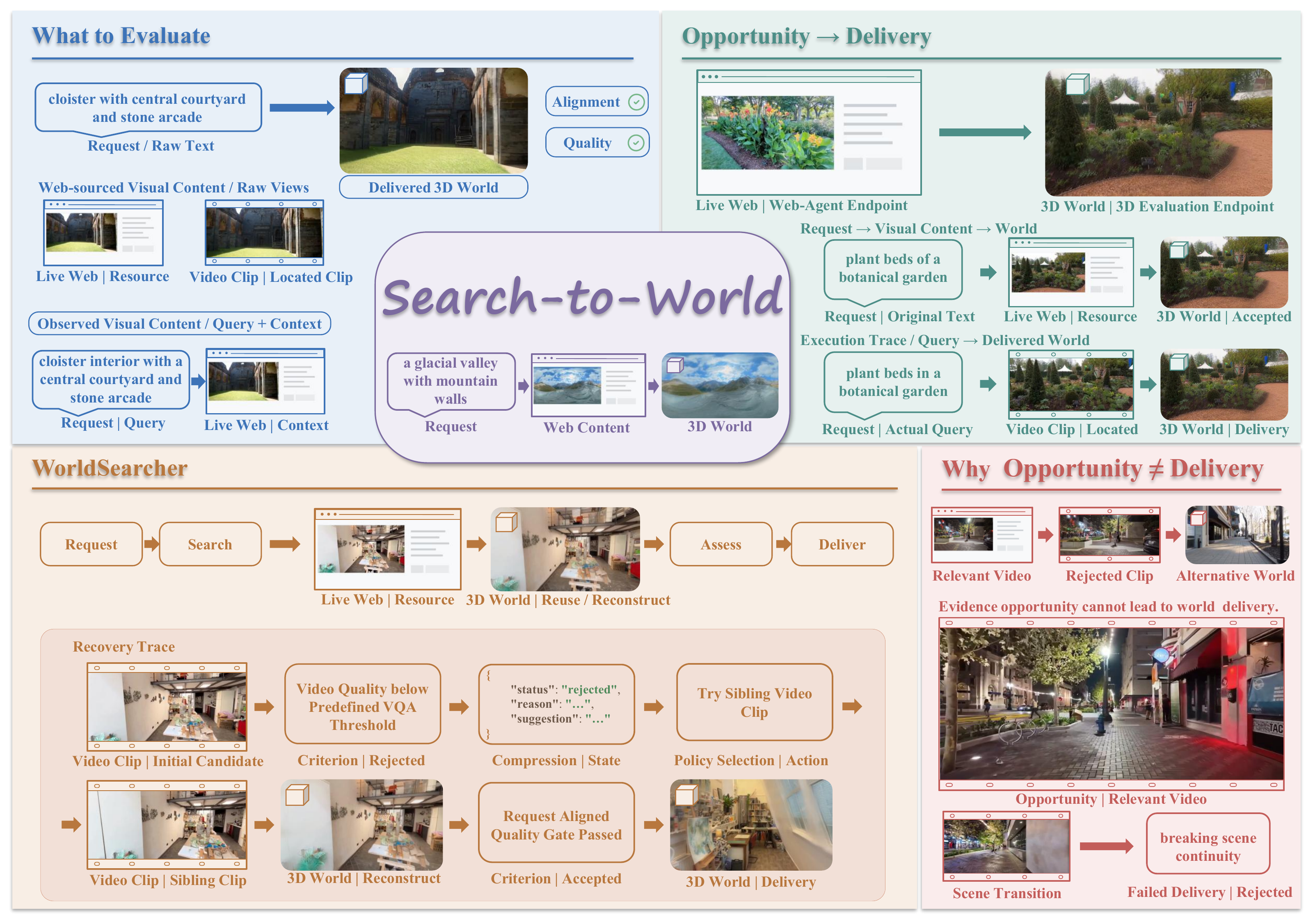
Task overview
Observe relevant content. Deliver a request-aligned, perceptually acceptable world.
Search-to-World measures these as two distinct outcomes.
Abstract
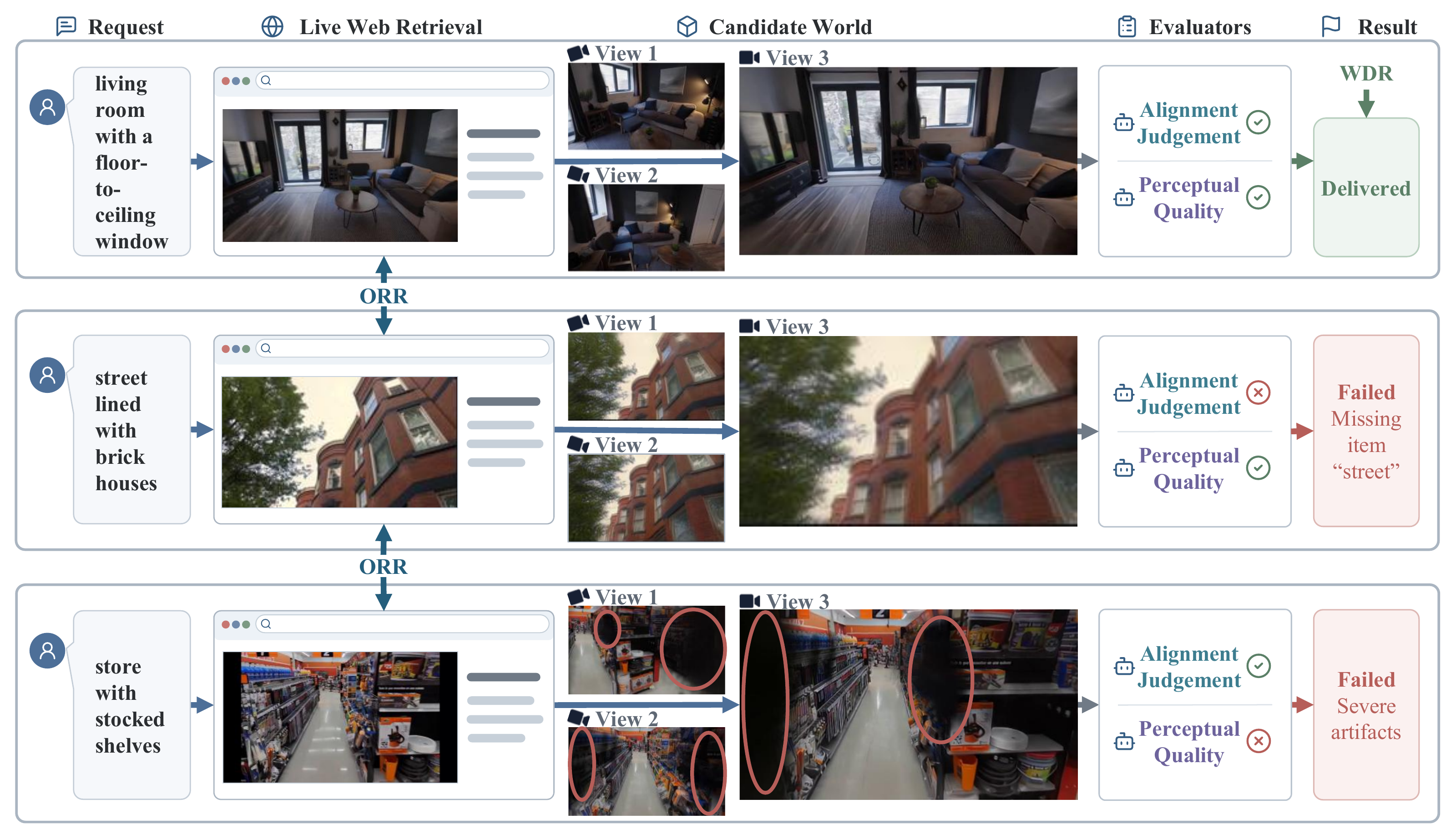
Agentic systems can understand user requests, search the live web, and use external tools to complete complex tasks, yet whether they can carry a user request through relevant content web retrieval to a usable 3D world has not been systematically evaluated. Both an established end-to-end pipeline and benchmark for evaluating it are missing. The core problem is bridging the gap from retrieval to delivery: relevant web-sourced visual content must be successfully turned into a request-aligned and perceptually acceptable 3D world.
We address these gaps separately. First, we introduce Search-to-World, an evaluation task that defines an end-to-end pipeline from a user request through web-sourced visual content retrieval to the delivery of a usable 3D world. Observed Retrieval Rate (ORR) and World Delivery Rate (WDR) are proposed as two metrics to distinguish observing relevant web-sourced visual content from successfully delivering a 3D world. Second, we present WorldSearcher, a reuse-then-reconstruction harness system that connects existing search agent systems to 3D world delivery. It first seeks available 3D worlds for reuse, and then falls back to video-based reconstruction when no reusable worlds are retrieved.
We also design a structured recovery control in WorldSearcher to revise temporal grounding, replace source videos, or reformulate queries for failure recovery. We benchmark several widely used models on the Search-to-World task using WorldSearcher and conduct an ablation study of supervised fine-tuning (SFT) for the core models used by recovery subagents, thereby validating the recovery control of WorldSearcher. Our results reveal that Search-to-World delivery varies with the model used by the agentic system and that observing relevant web-sourced visual content alone does not guarantee successful delivery. More importantly, joint training of the recovery agents improves both delivery success and action efficiency.
Overall, Search-to-World makes the capability of 3D world delivery by an agentic system measurable, while WorldSearcher provides an effective harness system with complementary recovery components.
WorldSearcher
A reuse-first harness with video reconstruction and structured recovery.
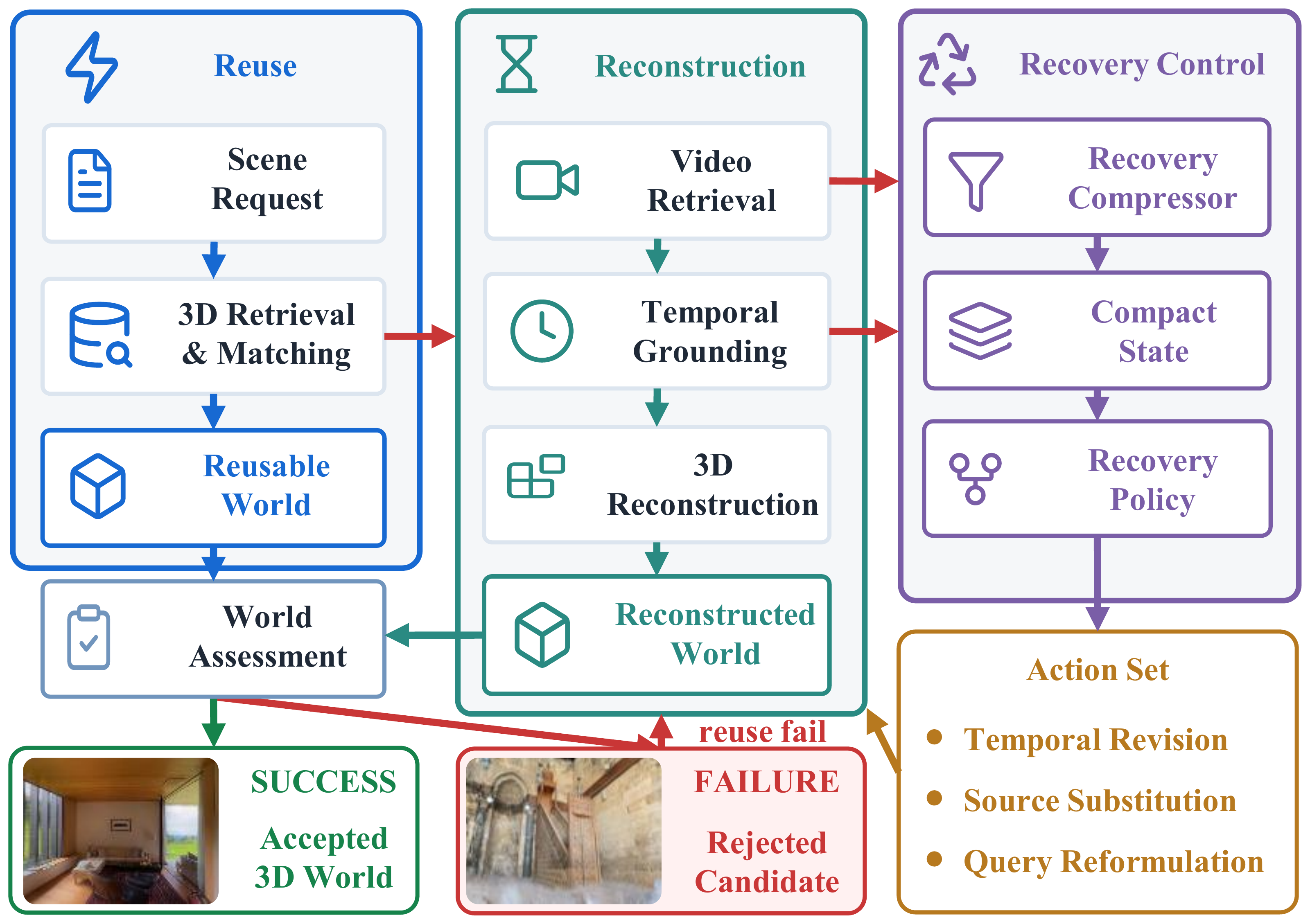
Reuse first. Retrieve an existing 3D world aligned with the request.
Reconstruct when needed. Ground a source video in time and reconstruct a candidate world.
Recover with structure. Revise the time interval, replace the video, or reformulate the query.
World gallery
Every world from the demo, in a slower 10-second loop.
Explore reusable 3D worlds and video-based reconstructions.
Use the previous and next buttons, swipe, or use the left and right arrow keys to explore one world at a time.
BibTeX
@article{gu2026searchtoworld,
  title   = {Search-to-World: Evaluation of 3D World Delivery
             from User Request through Web Search},
  author  = {Gu, Zixiao and Chen, Yabo and Xiang, Xunzhi and
             He, Yu and Huang, Haibin and Zhang, Chi and
             Wang, Yunbo and Li, Xuelong},
  journal = {arXiv preprint arXiv:2609.07605},
  year    = {2026}
}